Electrical engineering has a reputation problem. The name alone conjures images of dense textbooks, oscilloscopes, and people who casually speak in equations. If you have no technical background, it can feel like a club with an invisible entrance exam. But here is the truth: electrical engineering is a hands-on, learnable field, and the best way in is through your own two hands. You do not need a degree to begin. You need curiosity, a few cheap parts, and a plan. This roadmap walks you through how to get started with electrical engineering as a hobby or a possible career, with a clear first step you can take this week.
What Electrical Engineering Is Really About
Strip away the jargon and electrical engineering is about controlling the flow of energy and information. That is it. When you dim a lamp, you are controlling energy. When you press a key and a letter appears on a screen, you are controlling information. Electrical engineers design the systems that make both happen, from the power grid that keeps your fridge running to the tiny chip inside your phone.
The field splits into a few broad areas. Power engineering deals with generating and distributing electricity. Electronics focuses on circuits and components like resistors, capacitors, and transistors. Signal processing is about extracting meaning from waves, whether sound, radio, or sensor data. Control systems keep machines stable and responsive, from drones to factory robots. And embedded systems blend hardware and software into devices that sense and react to the world. You do not have to pick a specialty now. In fact, you should not. The point of starting is to sample the territory and see what pulls you in.
What surprises most beginners is how much of electrical engineering is about debugging and patience. Circuits rarely work the first time. A wire is loose, a component is backwards, a value is wrong. The skill you are really building is a calm, methodical approach to problems. That skill transfers to every branch of the field and to plenty of jobs outside it.
Another surprise: you already use electrical engineering every day. Your phone charges, your Wi-Fi connects, your car starts. Each of those is a small miracle of design. Once you start learning, ordinary objects become fascinating puzzles. That shift in perception is one of the best reasons to begin.
First Skills to Build as a Beginner
You do not need to master calculus before you touch a circuit. Start with the practical skills that make everything else easier, and let the theory grow alongside them.
Safety first, and mean it. Electricity can hurt you, but the voltages in most beginner projects are harmless if you follow basic rules. Never work on mains wiring. Unplug power before changing a circuit. Keep one hand in your pocket when probing live low-voltage circuits. Wear safety glasses when soldering or clipping wire. These habits are not optional, and they are easy to learn.
Learn to read a schematic. A schematic is a map of a circuit. It uses simple symbols for components and lines for connections. You can learn the common symbols in an afternoon: resistor, capacitor, LED, battery, switch, ground. Being able to look at a diagram and picture the physical build is the single most useful beginner skill. Practice by redrawing simple circuits from a book or a kit on paper.
Understand voltage, current, and resistance. These three ideas explain most beginner circuits. Voltage is the push, current is the flow, resistance is the squeeze. Ohm’s law ties them together: voltage equals current times resistance. You do not need to memorize derivations. You need to feel what happens when you change one value. A higher resistance means less current for the same voltage. That intuition will guide your troubleshooting more than any formula.
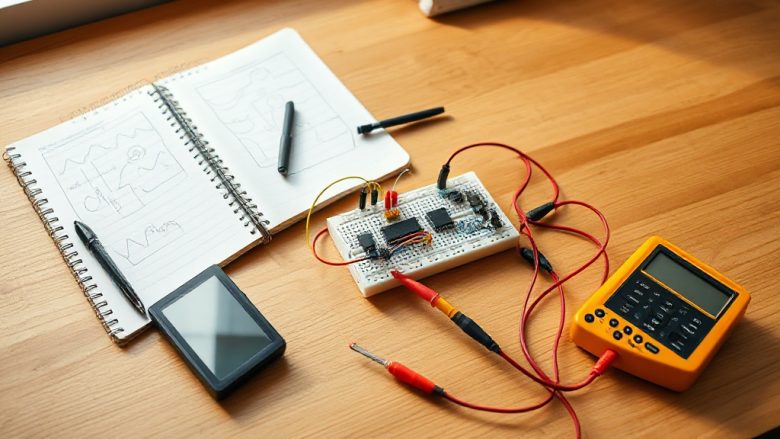
Get comfortable with a multimeter. A multimeter measures voltage, current, and resistance, and it is the beginner’s best friend. Buy a cheap one and measure everything: batteries, wall adapters, resistors, your own skin. Learn to check continuity to find broken connections. This one tool will save you hours of guessing.
Practice soldering. Soldering connects components permanently. It looks intimidating but it is a motor skill, and motor skills improve with repetition. Buy a practice board and some scrap wire. Aim for shiny, smooth joints, not blobs. Ten minutes a day for a week and you will be competent enough for most kits.
Learn a little programming. Modern electrical engineering leans heavily on code, especially in embedded systems. Start with a beginner-friendly language like Python or the C-like language used by Arduino boards. You do not need to become a software engineer. You need to make a light blink on command and read a sensor value. That is enough to unlock a huge range of projects.
If you prefer a structured path, a short online course or a well-reviewed beginner book can give you order. But do not spend months reading before you build. The fastest learners alternate between theory and practice, one chapter, one circuit, one chapter, one circuit.
A Simple Starter Project to Build Confidence
The best first project is one that works quickly, teaches several skills at once, and does not cost much. A blinking LED with a breadboard and a microcontroller is the classic choice for a reason. It is the “hello world” of electrical engineering.
Here is the shape of it. You will need a small microcontroller board, a breadboard, a few jumper wires, an LED, and a resistor. A breadboard lets you push components into holes without soldering, so you can rearrange and experiment freely. The microcontroller is a tiny computer you can program. The resistor protects the LED from too much current. The LED is your output, the visible sign that your circuit works.
Your goal is simple: make the LED turn on and off in a pattern. You will write a short program that sets a pin high, waits, sets it low, and repeats. When you upload that program and the LED blinks, you have just built a complete system: power, control, code, and output. That is electrical engineering in miniature.
Do not stop at a blink. Change the timing. Add a second LED. Make them alternate. Add a button and make the LED respond to your press. Each small variation teaches something new about inputs, outputs, and logic. This is how beginners become builders.
Once you are comfortable, expand in a direction that interests you. If you like music, build a simple tone generator. If you like gardening, build a soil moisture sensor that lights up when a plant needs water. If you like robots, start with a small wheeled chassis and a motor driver. The project matters less than the loop: imagine, build, debug, improve. That loop is the real curriculum.
Keep a notebook. Write down what you tried, what failed, and what you learned. Months later, that notebook will be more valuable than any textbook, because it is your own record of thinking like an engineer.
Finally, find a community. Local makerspaces, online forums, and hobby clubs are full of people who remember being where you are. Ask questions. Share your failures. Offer help once you can. Electrical engineering can look solitary, but it is learned in conversation as much as in isolation.
You do not need permission to start. You need a breadboard, a few parts, and the willingness to be confused for a while. The confusion fades. The curiosity stays. Pick one small project this week, and let it be messy. That is how every electrical engineer begins, and it is how you will begin too.